viernes, 19 de octubre de 2012

Surfing Europe – Impressions from the GoPro

“You can’t stop the waves, but you can learn to surf”Jon Kabat-Zinn

Surfing in Europe with a GoPro

When I first started surfing about three years ago I knew that this new hobby was here to stay. In the years that followed I began choosing travel destinations mainly base don wave power and water temperature and grew to know some of the best surf spots around the world. During my recent surf trip I realised once again how amazing Europe is: we have so much culture, such incredible history and a stunning variety of waves and gorgeous beaches.

This summer my friends and I decided to hit the road for 7 weeks to cruise down the French and Spanish coast with one big goal in mind: we wanted to ride the best waves out there. Oh boy and we did! To capture our fun surf sessions we brought along a GoPro camera, which can be attached to the surfboard and record all those unique moments spent out in the ocean (for more information about the GoPro also check the previous article here). Here are a couple of impressions from our surf adventures in Spain ( San Vicente de la Barquera) and Frannce (Moliets et Maa) – enjoy!

jueves, 18 de octubre de 2012

How to choose and use a backpack

For everyone who enjoys some backpacking every now and then, check out this infographic by backpack provider REI explaining all you need to know about weight distribution when packing ( I never know whether the heavy stuff goes on top or in the bottom), the right size of backpack to buy as well as some essentials you ought to bring with you. Personally I disagree with leaving your blow-dryer at home (nothing like a good blow-dry when you’re on the road) but other than that, there are some pretty good tips here. Enjoy.

How to choose and use a backpack

jueves, 11 de octubre de 2012

Laughter and reduced backpack help 71-year-old Knox woman complete AT thru-hike


Barbara Allen is back home in Knoxville, but her biological clock is still on the Appalachian Trail. She wakes up at 5 a.m., and by 7 p.m., she's ready for bed. She'd like to finish her online trail journal, but she can't sit still that long."I feel a need to keep moving," Allen said recently. "I have this constant urge to get up and walk."

On March 5 Allen set out from Springer Mountain, Ga., to hike all 2,180 miles of the Appalachian Trail, the world's longest continuous footpath. Six months and approximately 5 million footsteps later, she reached the trail's northern terminus atop Mount Katahdin, in central Maine. The date was Sept. 6. The weather was gorgeous, and Allen didn't cry.

"I thought I'd be emotional, but I wasn't, which is very unusual for me," she said. "I was just so relieved to have made it."

Allen is 71 years old. In all likelihood, that makes her the oldest person from Knoxville to thru-hike the A.T.

A retired public health worker, Allen didn't take up backpacking until she was 40 years old. One of her inspirations was News Sentinel columnist Carson Brewer, who wrote extensively about Great Smoky Mountains National Park. After taking a noncredit course in backpacking from the University of Tennessee, she embarked on numerous hiking trips, both home and abroad.

Allen had just returned from backpacking in Chile and Argentina a year ago when she realized the time was right to tackle the A.T.

"My conclusion was it was time to get out there and do something rather than sit around and be bored," Allen said. "So I closed my house, picked up my backpack, and started down the trail."

Initially, Allen's pack weighed 30 pounds. To lighten her load, she got rid of her cook stove and began eating peanut butter, cheese, and foods that could be re-hydrated in cold water. In Damascus, Va., she switched from leather Gore-Tex hiking boots to lightweight trail shoes. Her knees held up the whole time, and she never had a single blister.

"Ounces add up to pounds," Allen said. "I used to carry 45 to 50 pounds for a weeklong backpacking trip. Now, I carry half that."

Allen especially enjoyed the flow of humanity along the A.T. For six months she was immersed in a culture in which every thru-hiker had a trail name. She remembers Yosemite, Skunk Ape, Rhino, and especially Machete Mitch, who carried only a machete and a video camera in his determination to live off the land.

"He didn't last long," Allen said.

Allen's trail name was Mamaw B ( "I was everyone's grandma along the trail," she said.). Her closest hiking companion was a 54-year-old woman from Tampa, Fla., whose trail name was Rainbow, and often they were accompanied by a 23-year-old woman from California named Nutter Butter.

Why would a young lady choose two older women as hiking companions? Allen said it was partly because she and Rainbow kept a strong pace, but more importantly, they had fun.

"There were times when we couldn't hike because of all the laughing," she said. "We had the most ridiculous conversations. We solved the world's problems."

Rainbow and Allen (aka Mamaw B) started hiking together at Chestnut Knob, in Virginia. Two hundred miles from the finish, Rainbow began to feel pain in her groin that she attributed to some minor falls she'd had earlier. After hiking another 160 miles into Maine, she fell again. This time, she couldn't continue. Just 42 heartbreaking miles from the finish, Rainbow had to quit. When she arrived home, X-rays revealed two pelvic fractures.

The Appalachian Trail Conference estimates that this year 2,500 thru-hikers started from Springer Mountain hiking the A.T. northbound, while 330 thru-hikers set out southbound from Mount Katahdin. A record 1,016 northbounders (including Allen) signed in at Harpers Ferry, W. Va., the trail's unofficial halfway point. Last year the completion rate for thru-hikers was nearly 30 percent. Also, Allen's time of six months was about average since most people take anywhere from five to seven months to finish the A.T.

She saw seven black bears along the way, most of them in Virginia's Shenandoah National Park. The northern New England section of the A.T. was especially hard because it came at the end and had the worst rocks. Allen said the toughest section for her was the Mahoosuc Notch, a mile-long, boulder-choked gap through the Mahoosuc Range of western Maine.

By the end of the hike she had lost 35 pounds. Her blood pressure dropped from 169/83 to 126/70, and her heart rate went from 70 to 50 beats-per-minute. To her delight, she discovered she could climb 4,000 feet without having to rest.

Unlike many of the younger thru-hikes, Allen never got in a hurry. The most she hiked in one day was 25 miles, but 20 miles was the norm. She stayed on schedule, but was never in such a rush that she wouldn't stop to enjoy a trailside pond in Maine, or a scenic overlook in North Carolina.

The trail towns brought Allen some of her best memories. She left the A.T. every three to five days to resupply, and in towns like Waynseboro, Va., and Hanover, N.H., she encountered a veritable band of trail angels ready to spread their trail magic.

Like the lady in the beauty salon in Duncannon, Pa., who gave thru-hikers $5 haircuts.

"Before the hike I was getting a little cynical about society, but I found a lot of good people out there," Allen said.

martes, 9 de octubre de 2012

Misplaced Luggage is no longer a problem

OVER 30 MILLION BAGS ARE MISPLACED EVERY YEAR DURING INTERNATIONAL AND DOMESTIC FLIGHTS. 3,000 BAGS EVERY HOUR OF EVERY DAY!


Misplaced Luggage is no longer a problem
Lug Loc, Luggage Locator.
It also a fects 42 million passengers annually and is the second most important factor in having a pleasant trip. An indemnity may relieve your wallet. But recovering your belongings will for sure comfort your spirit.

Whether it is about work documents, a much-needed medication or souvenirs or presents for your family, it is great to have your luggage back. Your bag is not at the conveyor belt? Just call, e-mail or SMS us. Simple and reliable.

LUGLOC DOES NOT INTERFERE WITH ANY AVIONIC SYSTEM

The state-of-the-art GSM technology designed by our investigators give the LugLoc system the unique ability to act within minutes in any airport in the world to locate any protected item. Put your LugLoc inside the bag you are checking-in and the system will locate it in any airport around the world.

The most ubiquitous LUGgage LOCation system: Thick clouds? Piled in a thick-walled warehouse? Unlike the GPS, this is no problem for LugLoc! State-of-the-art technology to track your luggage in

Website for more information: www.LugLoc.com

jueves, 4 de octubre de 2012

Charlie: The guy with the backpack

Senior Airman Charles Sothikhoun at Kunsan Air Base
Senior Airman Charles Sothikhoun at Kunsan Air Base.
KUNSAN AIR BASE, South Korea (AFNS) -- Charlie, the guy with the backpack, is something of a local figure.

He roams the Kunsan Air Base nightlife scene with his survival-kit backpack, prepared to help however he can, whether it's assisting a fellow Airman home or "super gluing" a girl's broken heel.

Parched? He has water. Bug bitten? He has bug spray and itch cream. Injured? He has bandages in his first aid kit. He's ready for any situation, typical or far-fetched -- rope, a signal mirror, Midol, roach spray, Gorilla Glue and much more.

A quiet and unassuming guy, Senior Airman Charles Sothikhoun, 8th Maintenance Squadron nondestructive inspector, is hesitant to take credit for his good deeds. When asked whether he once dug through a sandpit for eight hours to help a stranger find his wedding band, he responded, "Oh, that? It was only six hours."

Although "Charlie," as he's known around the Wolf Pack, wouldn't talk about all the ways he has helped people, there was an outpouring of witnesses willing to vouch for this ultimate wingman.

"Charlie is everyone's best friend here, whether they realize it or not," said Senior Airman Justin Ogburn, 8th MXS precision-guided munitions crew chief. "It's almost like he has a sixth sense for someone in need. I don't know how many times I have needed him for bug spray, and he just shows up out of nowhere.

"I had a bike wreck a few weeks ago and posted about it on Facebook," Ogburn continued. "Charlie came and found me after work to see if I needed first aid. He is always concerned for his fellow Airmen, and that is what makes Charlie the greatest wingman ever."

Bug spray is one of the most requested items from Charlie's arsenal, but he's also prepared for any situation that might arise -- rubber gloves, flashlights, umbrellas, beef jerky, a sewing kit and much, much more. And, if a comrade's blues uniform ever needs spiffing up on a Monday, he carries a lint brush and shoe polish as well.

So what leads him to voluntarily carry around his 20- to 30-pound backpack on a daily basis? Was there some event that sparked the creation of his store of random, yet useful, supplies? Does he feel like a superhero helping so many people?

Getting Charlie to divulge these details took some coercing.

"I'm not a vigilante who has a specific reason I decided to start doing this," said Charlie. "I just do what I believe is right. People are trying to have a good time, and I want to make sure no one gets in trouble or is forgotten or left alone. I do it to the best of my ability.

"I do it every night because there is always someone else working, too," he added. "Cops, civil engineers, the air traffic controllers, flightline workers, officers ... they are all working."

Although a quiet person, he's not shy about approaching any situation to make sure everyone is alright.

"Charlie once stopped to make sure I was okay walking home with the group I was with," said Senior Airman Kelli Brown, previously with the 8th MXS but now stationed in England. "I'm a girl and a mechanic, so most of my friends are men. It was very sweet of him to make sure it was the right circumstance.

"He is such a truly caring, responsible and kind person. I don't know how he is always so prepared, no matter what situation you're in, but it's a blessing," Brown added. "We should all aim to be better wingmen like Charlie. This would be a much better Air Force if we took half as good of care of everyone as he has his Kunsan family."

Charlie's efforts have been recognized at all levels, from the wing commander when he earned Kunsan AB's "Pride of the Pack," to group commanders at softball games and, most importantly, all the Airmen he helps.

"He personifies the wingman concept," said Chief Master Sgt. Todd Boyle, 8th MXS superintendent. "At a base like Kunsan, it's reassuring to know someone like him is looking out for friends and families. He's given me bug repellent at the Loring Club before, and I've seen him give someone medicated ointment for their rash. He's not in it for the recognition ... he really cares about the Wolf Pack."

There were many accounts of his kindness: providing Neosporin and Band-aids, helping a friend spackle up holes in his dorm room wall, countless times he handed out water bottles.

"I have no doubt Charlie would give you the shirt off of his back in a blinding blizzard," said Staff Sgt. Alfonso Vigil, 8th MXS. "Scratch that ... he wouldn't have to. I'm sure that bag of his has an emergency blanket and hand warmers in it."

martes, 2 de octubre de 2012

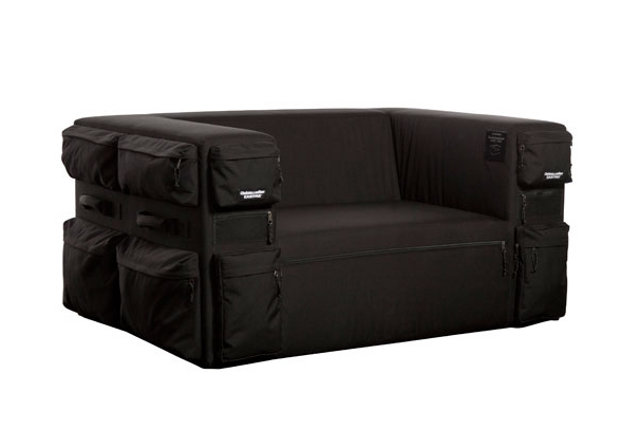
Quinze & Milan + Eastpak = Backpack Couch

THAT´S RIGHT, A BACKPACK/COUCH.


This is the $2,060 Eastpak Sofa. It's a little sofa made out of backpack fabric that has a bunch of pockets for all your stuff. Like so many other things, I half want it and half think it's stupidest thing ever made. I would like it more if all the compartments were detachable though.  Hit the jump for a couple more shots including what the couch looks like IN BLACK. That's right, color options!


Sick of losing things in between the seat cushions? As much a giant mutant backpack as a piece of multi-functional living room furniture, this design concept blends the best storage elements of a travel pack with the comfort of a conventional love seat. Biggest backpack or smallest sofa in the world? A bit of both.

Unsurprisingly, this produce is a piece of collaborative design between a backpack company (EastPack) and a furniture design firm (Quinze & Milan). It is upholstered in strongly-colored, heavy-duty fabric with zippers, handles, straps and everything else you would expect from your standard vacation gear. Inverting the hidden multi-functionality of your typical hide-a-bed or futon design, everything this sofa has to offer is right out in the open.

For those who love the nature-loving aesthetics of high-end eco-gear, these shapes, styles and textures will look and feel comfortably familiar. Better yet, they have neat niches of all sorts in which to store your favorite books, magazines, computers, remotes and other household gadgets. For sectional sofa fans, there is also going to be a side chair to sit in – one that will fit snugly next to your super-sized hybrid backpack/couch.


jueves, 27 de septiembre de 2012

Tips for Buying the Best Hiking Backpack

So you’ve decided to go hiking. You’ll need a good backpack to hold all your hiking essentials. When you’re shopping for a backpack, consider how much you plan to carry with you. This will help you decide which is the best hiking backpack for you. How much you will carry depends on how long you’re going to hike and what the conditions are going to be throughout your hike. If you’re planning an overnight hiking trip in a place where you can easily grab food in a snack bar or diner, a small backpack would most likely be sufficient, but if you’re going on a week long hike out in the wilderness, you’ll need a much bigger backpack, obviously.

On the average, you will need one gallon (3 to 4 liters) of water for each day you are hiking. Of course, depending on your size, activity and general conditions in the area, that number can vary. And again on the average, you will need 1 to 2 pounds of food for each hiking day. If you’re in shape and you’re planning to hike from morning until evening, you could probably get by without food, just water. Remember, though, that hiking is a calorie burning activity so you’re likely going to eat more food than you usually do. While hiking is a good weight loss activity, you shouldn’t forgo sugars, salts and other nutritional components. You’ll also need to up your intake of fluid while you hike as electrolyte imbalances can make you more exhausted than usual.

You should also consider your overall fitness level when you’re shopping for a backpack. If you’re truly fit, you’ll be able to carry more weight much farther. However, try not to go overboard; even the most experienced hikers aim to minimize the load they have to carry. This load is often referred to as FSO (From the Skin Out) weight, and includes the weight of a loaded backpack (which could be 20 to 50 pounds, even more), socks and shows (around 3 pounds), and so on. Then there is what’s called pack weight, which includes only the weight of an empty backpack. Pack weight can vary due to the material and how much aluminum tubing is used in the construction of the backpack.

How you plan on carrying the weight is another thing you have to consider when shopping for a backpack. Most backpacks have several internal and external flaps and pockets, loops and buckles for carrying add-ons. Some backpacks have flaps that flip over the whole pack, keeping out dirt and water. The smaller flaps in some backpacks cover the buckles and other components that could prove to be uncomfortable or are likely to snag. The loops and buckles let you carry bungee cords, hiking poles, water bottles, tenting equipment and such.


When you pack, make sure you put most of the weight inside the backpack; otherwise, the backpack will be out of balance and will be much more difficult for you to carry. In addition, your backpack is more likely to get caught on tree branches and bushes that way. When you’re packing for a hike, think light, tight and confined.

Don’t just buy the first backpack you come across or that happens to catch your attention. Try out a few backpacks. Your backpack needs to be comfortable for you to carry, as well as be the right size for your build and height. Remember that you will be carrying your backpack and everything in it for hours, and even days. Make sure the backpack has adjustable shoulder straps with plenty of slack, as well as belt loops.